
TFCG’s work in the South Nguru Mountains
The discovery by TFCG and others between 2004 – 2006 of 16 new endemic reptile and amphibian species in the South Nguru Mountains highlights the extraordinary diversity of the mountains. Working closely with government and other civil society organizations, TFCG have supported the establishment of new village land forest reserves in the South Nguru landscape and have helped to improve the management of the Mkingu Nature Forest Reserve and Kanga Forest Reserve.
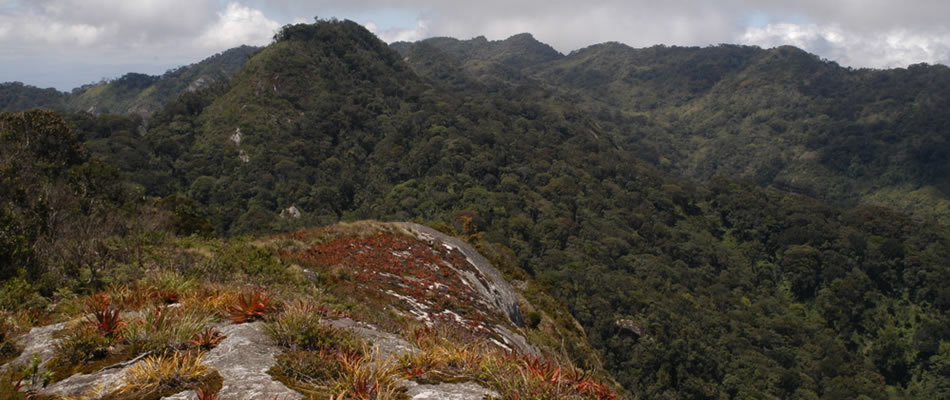
The South Nguru LandscapeThe South Nguru landscape includes 34,000 ha of Eastern Arc montane, submontane and lowland forest. Communities living immediately adjacent to the forests are predominantly small holder farmers growing bananas, yams, cardamom, cocoa and some maize. Approximately 46,000 people live within 5 km of the forest. In the lowlands there is the largest sugar plantation in Tanzania which has also drawn people into the area. The South Ngurus have 16 strictly endemic vertebrate species and 23 Eastern Arc endemic vertebrates. There are at least 53 Eastern Arc endemic species of plant in the South Nguru Mountains including an endemic African violet. Creating a vision for an extraordinary landscapeSince 2004 the Tanzania Forest Conservation Group has been supporting the conservation of the South Nguru Mountains. TFCG’s work has also highlighted the plight of these forests including widespread illegal logging, hunting and forest clearance. By bringing stakeholders together and with support from European Union and the Government of Denmark, TFCG helped local communities, government and private sector to develop a vision and strategy for the landscape and to begin to put that strategy into place. |
The Adding Value to the Arc projectThe Adding Value to the Arc project was active between June 2013 and March 2018. The project was funded by the European Union and was implemented by the Tanzania Forest Conservation Group (TFCG), the Community Forest Conservation Network of Tanzania (MJUMITA), the Tanzania Forest Services Agency and Mvomero District Council. The project aimed to strengthen participatory forest management and sustainable economic development around the South Nguru Mountains The project had a strong emphasis on developing ecologically sustainable, forest-based revenues for communities including sustainable charcoal production, sustainable timber harvesting; and eco-tourism. Between 2013 and March 2018, the project assisted 11 villages to establish Village Land Forest Reserves covering 13,501 hectares.
|

TFCG Publications about the South NgurusLyimo, E. 2018. Adding Value to the Arc Project: the endline household livelihood survey. TFCG. 1 -53 TFCG, 2018. Adding Value to the Arc Project: photo stories of project activities in 5 villages. TFCG TFCG, 2018. Adding Value to the Arc Project: photo stories of project activities in Msolokelo Village. TFCG TFCG, 2018. Adding Value to the Arc Project: photo stories of project activities in Masimba Village. TFCG TFCG, 2018. Training materials on poultry husbandry. Lyimo, E. 2016. Lessons learned on resource mobilisation and allocation for Nature Reserves under Joint Forest Management in Tanzania. Workshop Proceedings. Kitine, F. 2015. Monitoring village governance in six villages practising community-based forest management in the South Nguru Mountains Vyamana, V. G., N. Amuri, W. A. Mugasha, P. Hieronimo and S. Mourice, 2015. Climate Smart Agricultural Options for Small-scale Farmers in the South Nguru Mountain Landscape, Mvomero District, Morogoro. TFCG Technical Report 46. Lyimo, E. 2014. Adding Value to the Arc project: a baseline household livelihood survey. TFCG. 1 – 54 TFCG. 2014. Adding Value to the Arc Project LeafletProject Leaflet. TFCG. 2013. Adding Value to the Arc. Project Poster. May 2014. Doggart, N. and D. Loserian (eds.) 2007. South Nguru Mountains: A Description of the biophysical landscape. TFCG Technical Paper No 11. DSM Tz pp 1 – 71. Mwakalinga. H. 2007. Household economy survey report. LIVING Project for Nguru South Eastern Arc Mountains. CARE Technical Report. Kilemile, J. 2007. Baseline Survey Report on Social and Representational Status. CARE Technical Report. LIVING. 2007. Gender issues assessment report conducted in villages surrounding South Nguru Mountains, Mvomero, Morogoro. CARE and TFCG Technical Report. Bracebridge, C. 2006 Mkindo Forest Reserve Forest Disturbance Report. Report for Tanzania Forest Conservation Group and Participatory Environmental Management Programme, Dar es Salaam. pp 1 – 64 Forrester-Kibuga, K. 2006. PEMA: End of Phase I External Evaluation Summary. pp 1 – 9. Forrester Kibuga, K. 2006. Nguru South Landscape: Participatory Situation Assessment & Collaborative Action Planning. TFCG Technical Report 14, Dar es Salaam, Tanzania. pp 1 – 30. Loserian, D., et al 2006. Nguru South. Landscape: Initial Characterization Report. TFCG Technical Report 13, Dar es Salaam, Tanzania. pp 1 – 63 Raben, K., et al 2006. Identifying local stakeholders in forest landscapes: Understanding the Use of Ecological Goods in the Kasyoha-Kitomi Landscape, Uganda and the Nguru South Landscape, Tanzania. TFCG Technical Report 16, Dar es Salaam, Tanzania. pp 1 – 32. Boesen, J., K. Raben, Z. Akello, M. Kidoido, and D. Lopa. 2006. South Nguru Landscape and Kasyoha-Kitomi, Uganda: Towards Monitoring of Poverty, Livelihoods & Knowledge-Attitude & Practices Impacts of PEMA. TFCG Technical Paper. Forrester Kibuga, K. 2006. Nguru South Landscape: Participatory Situation Assessment & Collaborative Action Planning. TFCG Technical Paper. Forrester-Kibuga, K. PEMA 2004, Project Leaflet. Project Newsletters and PostersAdding Value to the Arc Project Newsletter 2016 Adding Value to the Arc Project Newsletter 2015 Adding Value to the Arc Project Newsletter 2014 About the AVA Project. Poster. pdf AVA Project Activities in Pictures in 5 Villages. pdf AVA Project Activities in Pictures in Masimba Village. pdf AVA Project Activities in Pictures in Msolokelo Village. pdf |